Friday, August 12, 2011

Tuesday, May 10, 2011

Let's talk plants!

Well, now that we have designed our layout and considered our location, let's talk about what to plant.  My preference is to have perrenials that will spread and can be divided and put in other spots.  I think that having the same plants in gardens near each other is a thread that pulls them together.  Just like  color in the home, it is best to have a color scheme throughout the yard to give you a sense of cohesion.

So, do you like bright and vibrant colors?  Or is a soft and more Monet garden your style?   Also, be sure to think about the foilage on the plants, as the perrenials will not flower all season long.  So having some feathery foilage next to bold is a nice contrast and adds interest.  It is also important to think about the shades of green you will use.
Lime green looks great with vibrant tones, as does a dark green.  Blue and gray greens look wonderful with the softer most pastel flowers.


Here's a list of some of my favorite plants for shade:
  • Hostas
  • Coralbells
  • Hydrangeas
  • Astilbe
  • Anenomes
  • Ferns
  • Angel Begonias
For sun you have a huge selection to pick from.
  • Roses, especially the new varieties that do not need so much special care
  • Lilies
  • Achillea
  • Salvias
  • Rudbeckia
  • Coneflowers
  • Russian sage
Plant in multiples.  It is better to start with fewer varieties and have a good showing, than to have one of everything and nothing really shows.  Remember that when you start a perrenial garden, the first year most of the growth is in the root system, so you must be patient.  Add annuals for color and to fill in the spaces. 

You will be annually rewarded for your work, and have many years of pleasure.

Monday, April 18, 2011

Laying out the garden bed

Focal point
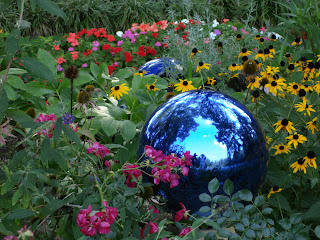
The  very first thing to consider in laying out your garden is the focal point.  Do you have a natural point of interest, such as leading up to the front door?   Do you want to direct traffic to another place in the landscape and add some interest to a small utility path?    Maybe there is no natural focal point in the landscape and you need to add it, with a fountain, statuary or something bright and reflective like this gazing ball.             


Savannah Front entrance
 The reason this is so important, is because it will determine the size of the plants, the structure of the plants, and also the color. 

The other very important issues to consider will be the amount of natural light available, and the size constraints you will have.

Six hours of nautural sunlight is considered to be a sunny location.  Less than that can use plants that are o-k in sun/shade locations.  You will also want to consider if the sun is morning or afternoon, as afternoon sun is more intense.  Also, will it be reflecting off a wall?

Do you want your garden to be formal or casual?
A home with formal lines, and a central front entrance calls for a formal layout in the front with the planting being symetrical to follow the lines of the house.  If it is a 2 story house, you will need to add some height to balance it out.  Larger trees planted out from the corner of the house will balance the height and offer the opportunity to add lower beds directly in front of the house and keep everything in scale.

If you live in a smaller home or condo, you may do most of your planting in oversize pots to bring color and personality to your space.  DO NOT use a cluster of small pots, as they dry out too quickly and look messy!

Always consider the natural surrounding in your landscape.  You can 'borrow' site lines from your neighbors yards or a natural area, and these will give you a start for the type of garden you will plant for it to look cohesive in the neighborhood.

What is beyond that back gate?
Lastly for today, consider the area you have to work with.  If it is a small confined area, look at the labels on the plants you purchase.  You will not want them to have to be pruned to size every few months for ease of passage.  Also, if it is a narrow space, you can consider climbing plants and vines for height and then lower shrubs or flowers to fill in the bottom of the space.  Take into consideration what type of paving you will use if it is a path.  Also, plan on something of interest at the end of the path to drive you eye towards it.  A painted gate as shown her is very simple, and can be tied in to the color of the plants.

Good luck with the plans, and next we will discuss some plant choices. 


Email me with any  questions you may have: donna@donnacomstockinteriors.com

HAPPY  SPRING  GARDENING!

Wednesday, April 6, 2011

Let's start at the beginning


Fotosearch photo

As promised, we are going to start at the beginning, and that always means with the soil.  I have gardened in Wisconsin, where the glaciers went through and left sand and stones in the soil.  It was rich, and well draining.  Then I moved to North Carolina, and here in Charlotte I started with clay which was literally as hard as a brick.  My poor husband bought 3 rototillers until he had one large enough to handle this hard soil.
I had it tested and found just the right amendments to make the soil drain, and let the roots expand.

My clay soil had to be amended as follows:
1/3 part existing soil
1/3 part perma- till
1/3 part mushroom compost
Dig the hole twice the width of the plant root ball, and a few inches deeper.

Blend the mixture well, add 3-4" to the bottom of the hole and tamp to remove air pockets. Place plant into the hole, and add prepared soil around the plant. Tamp as you go.  When planted and mulched, place hose at the base of the plant and water well.
If you do not receive about an inch of rain weekly the first year, it is a good idea to water. 

A good saying to remember here in the south is "plant high, they won't die...plant low and they won't grow."  That is because the clay soil acts as a bowl and the plants will drown if they don't get the proper drainage.

And don't forget to mulch.  A 2-3" layer will keep the temperature in the soil more consistent and will also keep the moisture in the soil longer.