Wednesday, May 9, 2012

Gardens need structure to give them interest, and to be pleasant to look at.                                                                  
 Whether you are planning on a very formal garden with a central focal point, or an informal english garden that is rather wild in nature and the mixture of plants, adding some type of border gives the eye a place to start and end.            


You can use hardscape materials such as a wall or fencing, or you can use border plants.  I feel that if you choose to use border plants, something that is green year round is the correct selection.  It will give your garden structure in all seasons.  Be sure to select a plant that will remain low and uniform in appearance to give it the neat look you are after.

Thursday, May 3, 2012

Setting a color scheme

I have just finished planting my annuals for the season.
Here in the lower South, we are lucky enough to be able to garden all year round.  So I will fill in with annuals for the upcoming season. 

For summer and fall, I have decided on a pallet of limes and hot pinks.  I love the contrast of the two colors.  I have alot of old oak trees on my property which gives me plenty of shade.  I think that using whites with different shades of greens, taking into consideration bloom time and leaf shapes makes for a really interesting garden  scene.

In all of my perenniel beds, I have shades of pinks, reds, yellows and greens.  My greens vary from the blue tones of hostas and lambsears, to deep greens.  So for this season, I have selected impatients, petunias, coleus, and sweet alyssum to spread among the others.  This will give me a continuous pop of color where it is needed, and mix in with the perenniels that will come into bloom at various times of the season.

Tuesday, April 24, 2012

Don't you just  love an all white garden?   Some people think it would be boring, but it is so not boring and there are so many plants to select from.  In the spring many ornametal trees have white blooms...dogwoods, cherries, and some types of crabapples.  Then there are the magnolias, bridal veil and many other shrubs.

And all of the bulbs, including tulips and daffodils.   You can have pansies in white, hydrangeas, lilies, roses, clematis.  There are just too many to name all of the perenniel, vines, and annuals you have to choose from.

The thing that is most important to remember is that with an all white garden, you need variety of shape, flowering season, and structure to keep it interesting.


As in the garden above, borders are importent.  Use boxwood, hostas, monkey grass, or any other low growing plants that will be uniform in height to contain your garden beds.  They add a sense of order and draw the eye.


Don't forget to add a focal point, such as a fountain, colored pot, or sculpture to give the garden interest.  Remember that it needs to look good  in every season, so take into consideration the shape of the planting without their leaves.  Interesting bark and shape are very important no matter what your color scheme!

Monday, April 9, 2012

Donna's Beautiful Garden: I think of my landscape the same as I think of the...

Donna's Beautiful Garden: I think of my landscape the same as I think of the...: I think of my landscape the same as I think of the rooms in my home.  I have certain 'rules' that are important to me. I like to have...
I think of my landscape the same as I think of the rooms in my home.  I have certain 'rules' that are important to me.

I like to have little 'vignettes' or focal points to draw the eye, like this hanging planter that is at the top of the driveway, just
before you turn the corner to go on the walk to the back veranda.  I find it's color and style eye-catching and draws people up to that spot.  The back is where we live in our home and that is also the part of our yard that we spend alot of time in.   I spend time sitting out there reading and visisting.  It is a wonderful place in the morning to watch the birds at the birdbath and greeting the day with their songs.


Take the time to smell the roses, and listen to the birds...it is therapy for the soul.

Friday, March 16, 2012

Donna's Beautiful Garden: fern frondsSpring is such a special season..it's m...

Donna's Beautiful Garden: fern frondsSpring is such a special season..it's m...: fern fronds Spring is such a special season..it's makes anything seem possible.  I am always excited to see new plants surviving the win...
fern fronds
Spring is such a special season..it's makes anything seem possible.  I am always excited to see new plants surviving the winter, and established ones growing larger and stronger.

It occured to me that gardens are like friends.
They take a while to grow and become established. Harsh environments that challenge them, make them all the more cherished when they survive and you see the real beauty they have to offer.  They take patience and give great joy.

Learn from the gardener, nurture yourself and accept help when it is neccessary

Friday, December 30, 2011

Donna's Beautiful Garden: A new year beginning, and soon the garden and seed...

Donna's Beautiful Garden: A new year beginning, and soon the garden and seed...: A new year beginning, and soon the garden and seed catalogs will arrive in the mail. How I love to sit next to a fire and look through...
A new year beginning, and soon the garden and seed catalogs will arrive in the mail.  


How I love to sit next to a fire and look through them and dogear the pages, planning  for spring planting!


It's always so much fun to see the new introductions of plants that I have loved in the past that have been stricken by bad weather or pests.


And then there is the fact that the garden is always changing.
Last year we took down 2 large oak trees as did some of our neighbors.  That has added alot more sunshine in a space that I always thought of as a woodland  garden.  Some of my hostas actually got burned, so I know I will be moving them and replacing them with something that can handle the sun.


That is the lovely challenge.  Seeing a need for change and addressing it.   The same with life, it seems.  The more things change, the more they stay the same...is that an oxymoron?


My very favorite catalog is White Flower Farm, and their plants are terrific.  I have never had one fail.  Can't wait for it to show up in my box sometime soon!

Tuesday, November 1, 2011

Time to get busy for a beautiful Spring!

Seems like an odd time of the year to be thinking of spring flowers, but this is actually the perfect time to tend to things.

This is the time of the year to plan for a lush lawn in the coming season.  Aerating and adding fertilizer will be a big help for next year.  The plugs you remove now will break down and the lawn will get deeper roots and a better start with the winter fertilizer.  Here in the south, we add lime to the lawn about 2 weeks before the fertilizer.  It is also so important to get all of the leaves up so the grass does not smother.

This is also the time that I tend to my schrubs.  I use Hollytone on all of my acid loving schrubs in March and September. 

When the leaves are off the trees, look at the structure and decide where to prune.
I find there are several reasons I might want to do some pruning.  Possibly I want to lift the limbs, cut some out of the center for better air flow and more interesting structure,
or for larger blooms and health of the tree.

And of course, there are the bulbs to plant...daffodils, tulips, crocus.  These early bloomers, along with the forsythia and heleboros are such welcome harbingers of spring!

Friday, October 14, 2011

Fall in all of it's Glory

We took a drive up to the Blue Ridge mountains over the week-end, and it was such a beautiful day.  The air was warm with just a soft breeze blowing. As you can see, the colors were not at peak yet, but with the clear blue sky, it was a glorious day.
I love it when the river is shallow with these big rocks to walk on and crawl over!


turning leaves
Falls at Yellowstone Prong
This waterfall dumps into the river seen above.  It is located at mile marker 418.8 which is the Graveyard Fields Overlook.  It is in the Pisgah Forest in an area that burned in 1925, so it is new growth forest and was named for all the stumps that looked like grave markers after the fire.

The hiking here is easy and the trails are not very crowded, so it might be a nice stop for you to make the next time you are in the mountains.

On a warm day, and with the river being so shallow, it is a lovely spot to sit and put your feet into the water, relax and listen to the music of the rushing water from the falls.

Friday, August 12, 2011

Tuesday, May 10, 2011

Let's talk plants!

Well, now that we have designed our layout and considered our location, let's talk about what to plant.  My preference is to have perrenials that will spread and can be divided and put in other spots.  I think that having the same plants in gardens near each other is a thread that pulls them together.  Just like  color in the home, it is best to have a color scheme throughout the yard to give you a sense of cohesion.

So, do you like bright and vibrant colors?  Or is a soft and more Monet garden your style?   Also, be sure to think about the foilage on the plants, as the perrenials will not flower all season long.  So having some feathery foilage next to bold is a nice contrast and adds interest.  It is also important to think about the shades of green you will use.
Lime green looks great with vibrant tones, as does a dark green.  Blue and gray greens look wonderful with the softer most pastel flowers.


Here's a list of some of my favorite plants for shade:
  • Hostas
  • Coralbells
  • Hydrangeas
  • Astilbe
  • Anenomes
  • Ferns
  • Angel Begonias
For sun you have a huge selection to pick from.
  • Roses, especially the new varieties that do not need so much special care
  • Lilies
  • Achillea
  • Salvias
  • Rudbeckia
  • Coneflowers
  • Russian sage
Plant in multiples.  It is better to start with fewer varieties and have a good showing, than to have one of everything and nothing really shows.  Remember that when you start a perrenial garden, the first year most of the growth is in the root system, so you must be patient.  Add annuals for color and to fill in the spaces. 

You will be annually rewarded for your work, and have many years of pleasure.

Monday, April 18, 2011

Laying out the garden bed

Focal point
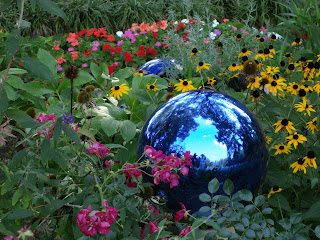
The  very first thing to consider in laying out your garden is the focal point.  Do you have a natural point of interest, such as leading up to the front door?   Do you want to direct traffic to another place in the landscape and add some interest to a small utility path?    Maybe there is no natural focal point in the landscape and you need to add it, with a fountain, statuary or something bright and reflective like this gazing ball.             


Savannah Front entrance
 The reason this is so important, is because it will determine the size of the plants, the structure of the plants, and also the color. 

The other very important issues to consider will be the amount of natural light available, and the size constraints you will have.

Six hours of nautural sunlight is considered to be a sunny location.  Less than that can use plants that are o-k in sun/shade locations.  You will also want to consider if the sun is morning or afternoon, as afternoon sun is more intense.  Also, will it be reflecting off a wall?

Do you want your garden to be formal or casual?
A home with formal lines, and a central front entrance calls for a formal layout in the front with the planting being symetrical to follow the lines of the house.  If it is a 2 story house, you will need to add some height to balance it out.  Larger trees planted out from the corner of the house will balance the height and offer the opportunity to add lower beds directly in front of the house and keep everything in scale.

If you live in a smaller home or condo, you may do most of your planting in oversize pots to bring color and personality to your space.  DO NOT use a cluster of small pots, as they dry out too quickly and look messy!

Always consider the natural surrounding in your landscape.  You can 'borrow' site lines from your neighbors yards or a natural area, and these will give you a start for the type of garden you will plant for it to look cohesive in the neighborhood.

What is beyond that back gate?
Lastly for today, consider the area you have to work with.  If it is a small confined area, look at the labels on the plants you purchase.  You will not want them to have to be pruned to size every few months for ease of passage.  Also, if it is a narrow space, you can consider climbing plants and vines for height and then lower shrubs or flowers to fill in the bottom of the space.  Take into consideration what type of paving you will use if it is a path.  Also, plan on something of interest at the end of the path to drive you eye towards it.  A painted gate as shown her is very simple, and can be tied in to the color of the plants.

Good luck with the plans, and next we will discuss some plant choices. 


Email me with any  questions you may have: donna@donnacomstockinteriors.com

HAPPY  SPRING  GARDENING!

Wednesday, April 6, 2011

Let's start at the beginning


Fotosearch photo

As promised, we are going to start at the beginning, and that always means with the soil.  I have gardened in Wisconsin, where the glaciers went through and left sand and stones in the soil.  It was rich, and well draining.  Then I moved to North Carolina, and here in Charlotte I started with clay which was literally as hard as a brick.  My poor husband bought 3 rototillers until he had one large enough to handle this hard soil.
I had it tested and found just the right amendments to make the soil drain, and let the roots expand.

My clay soil had to be amended as follows:
1/3 part existing soil
1/3 part perma- till
1/3 part mushroom compost
Dig the hole twice the width of the plant root ball, and a few inches deeper.

Blend the mixture well, add 3-4" to the bottom of the hole and tamp to remove air pockets. Place plant into the hole, and add prepared soil around the plant. Tamp as you go.  When planted and mulched, place hose at the base of the plant and water well.
If you do not receive about an inch of rain weekly the first year, it is a good idea to water. 

A good saying to remember here in the south is "plant high, they won't die...plant low and they won't grow."  That is because the clay soil acts as a bowl and the plants will drown if they don't get the proper drainage.

And don't forget to mulch.  A 2-3" layer will keep the temperature in the soil more consistent and will also keep the moisture in the soil longer. 


Friday, April 1, 2011

How to start a new flower bed


Gardening is a labor of love.  You've heard of curb appeal?  Well, that is what it adds to the value of your home. 

It also adds birdsong, flutterering butterflies, scent and color to your outdoor activities.

To have a successful garden takes some planning.
It needs to have structure, so it looks good throughout the seasons.  If you use perrenials they do not flower all year, and that has to be kept in mind.

I like to think about my 'hardscape' first.  That means walls, paths, fountains, and ponds.

A wall can be composed of many materials.  It can be brick or block, fencing, or a scrub border.  I have also used edging as a border.  The purpose of this is to separate and bring your eye to the level of the garden.  You'll also want to take in mind if your home calls for straight or curving lines.

I am going to give you a series of posts, taking you through this process. I will discuss soil maintenance, plant choices for different locations, using plants of differing heights, entending the season with the choice of plants, and bringing scent, birds & butterflies into the garden.

Please let me know what questions you may have that I might be able to answer for you.

Sunday, March 6, 2011

Spring has arrived!

flowering plum trees

pansies in full glory


emerging ferns


forsythia along fenceline


heleboros


Spring, in all of it's wonderful glory...awesome

I just returned from a week-end in Wisconsin, and loved seeing the fluffy white snow, glistening in the sun.  It really shows off the structure of the garden & plants.

However, when I returned home to Charlotte, everything had burst into bloom, the weather was in the high 60's and it was glorious! This is the very reason I love living here.  At least one of them.

As an avid gardener, I have the advantage of being outdoors every day of the year, and almost always have something in bloom. But, our springs are long, and so pretty.
These are some pictures of my gardens that I took this week, and they bring me such joy!  I hope you enjoy these fresh new beginnings, which make anything seem possible.

So, now is the time to get busy again.  So much to do.  Pull the early weeds, add compost, composted manure and mulch to all of the gardens.  I use hollytone on many of my schrubs, since we need to adjust our heavy clay soil.

But each autumn, I compost all of my leaves, and they turn into the most wonderful compost.  After 10 years here, my garden soil has turning into a much more workable, loose mixture, and with the minerals that the clay provides, my plantings are very happy.

So here we go...get ready, start, & get your hands dirty!


Friday, January 14, 2011

Redesigning a border

This is the border that runs up the side of our driveway.  It is especially lovely in the spring when all of the forsythia is in bloom.  Then later the roses, gardenias, nandinas and azalias bloom.  I also have some hydrangeas, butterfly bushes and lambsears in this bed. 

I love it that it has the monkey grass border that winds along the edges.  It is on a hill, and at the top end  the bed is much higher than the bottom.
Because of the erosion, my husband put up a low retaining wall at the top 1/3 of the bed.  It curves nicely from the azalias back to an arbor that holds roses and clematis.

Now, as I am perusing my new garden catalogs, I am looking for something to fall over the edges of the new wall to soften it, and pull all of the colors together.  It is mostly soft pastel pinks, lavenders, purples and grays.  I also have to consider that the cherry trees and crepe myrtles have grown and added more shade to that end of the bed. 

I am thinking of transplanting some hostas from other areas that now receive too much sun because we limbed up some of our wonderful old oaks.  They look better, have stood up better in the last ice storm we had, and bring more light into the house as well as the garden.   So, in those gardens I need to remove some things and add plants that prefer more sun.

As I have said in the past, a garden is everchanging.  And that is what I love about it!
It gives me a chance to share some of the lovely things I have, and exchange them for things that remind me of my friends when I enjoy the new planting in my garden.

Planning is part of the excitement of the coming new season. So many new colors, scents, varieties to choose from.  The catalogs are all dog-earred already.  I will go through them many times before I make my final choices.

Do you have any new areas that you are planning changes for?  I'd love to hear about them.  Share your thoughts.  Maybe I will use some of them! 
Donna

Wednesday, January 5, 2011

Donna's Beautiful Garden: A New Season

Donna's Beautiful Garden: A New Season: "I love getting my new garden catalogs in the mail, looking at all of the new selections and improved varieties of old favorites. Every..."

A New Season

I love getting my new garden catalogs in the mail, looking at all of the new selections and improved varieties of old favorites.  Every fall I look over my garden and decide what will need to be divided, what will need to be moved due to possibly a change in light because of trees either growing or having limbs removed. 

I like to have large swaths of plants that make a statement in my gardens, rather than a single plant of many different species.  I also feel that it is important to have something always blooming or of interest in every season.  I want my color selections to blend to create a more pleasing view.  I also want to have it look good from all angles, as my gardens are seen from the street, inside the house, and walking along the paths.

Therefore, it is important to have the structure of small trees and shrubs in my beds.
I like perennials, since they are less costly in the long run, reproduce, and once established, usually need less care and watering than annuals do.  However, I always include some annuals for continuous bloom throughout the season.

Getting the catalogs in the mail shows me new options, maybe new color selections of old favorites, and also maybe a new size than some of the older plants.  I find that all gardens are ever evolving, and that is part of the fun.  I find great pleasure in trading plants with friends.  It adds memories to a garden.
"In solitude we give passionate attention to our lives, to our memories, to the details around us." Virginia Woolf


So, stoke up the fireplace, gather the catalogs and dream & plan your new season!